Saturday, August 29, 2009

Memphis To Santa Fe

For more pictures, go to:
http://web.mac.com/rv8apilot/iWeb/Trip%20Pictures/Santa%20Fe.html


I had a week off, and I was itching to take Romeo Victor on a long cross country. The ideal cross country for me is under 800 nautical miles, or about two legs of two and a half hours. This allows us to arrive feeling fairly energetic, ready to explore the local area. We wanted to go somewhere different. We wanted cooler weather, hiking, biking and sight-seeing. We found our destination west of Memphis in Santa Fe, New Mexico. So,on Thursday, August27, 2009, The Missus and I loaded up the seven and filed IFR to Borger, TX. This was longer than I like for the first leg, but the weather around Oklahoma City was stinky, and I decided to go past the bad
weather before landing. The thunderstorms around this area were easily avoided using the Garmin 696. I had a slight headwind going westbound, but the fuel-sipping Lycoming engine running lean-of-peak gives me plenty of range (about five and a half hours with full tanks).


The folks at the FBO at Borger were very friendly, sending us off in their courtesy car for a lunch a the local Subway. Fuel was $3.69 per gallon, not bad at current market prices.


Continuing on to Santa Fe, we went VFR at 10,500 feet. I decided to fly to the southwest in order to approach Santa Fe from the south. This avoids the higher mountainous terrain to the east of Santa Fe. As it turned out, I didn't have much choice because there was a pretty good thunderstorm to the southeast of Santa Fe moving directly across our path. Using the 696, I deviated about 20 miles further to the south before turning inbound to Santa Fe. The dark wall of clouds on our right correlated with lots of red, yellow and lightning bolts on the Garmin display. It was a bit bumpy on the back side of the weather but we made it to the airport without penetrating anything significant.

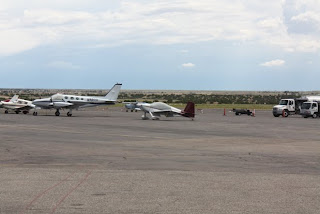
We were met by a vehicle at the taxiway which directed us to parking at Santa Fe AirCenter. The lady driving the vehicle helped us with the canopy cover and called to have our rental car brought to the airplane. The car was there in about two minutes. This is a very nice FBO, and I recommend it if you fly into Santa Fe.
We drove the few miles into Santa Fe and walked around the downtown plaza area where there are lots of tourist shops. There is some history in this town that predates even the pilgrims at Plymoth Rock. Santa Fe was originally discovered by Spanish conquistadores in about 1600 as they moved up from what is now Mexico. We toured the old church called San Miguel which was built around 1600 and destroyed by the Pueblo revolt in 1680. It was then rebuilt in 1710. We also checked out the Cathedral of St Francis, built in the second half of the nineteenth century.

Leaving Santa Fe, we traveled north, passing a number of Casinos run by the local Native
Americans and arrived at our hotel in White Rock, just a few miles from Los Alamos. We decided to stay here because it was central to a lot of the places we wanted to visit. We were only a forty minute drive to downtown Santa Fe from here with lots of hiking just a few minutes away. We checked into the Hampton Inn and had dinner at the one local restaurant, The Bandelier Grill. Not too bad.


Friday morning we awoke to a cloudless sky. We drove about ten miles to Bandelier National Monument, paid our $12 admission fee and went to the visitor center at Frijoles Canyon for a briefing from a very nice and helpful lady. This area is an archeological excavation of the home of hundreds of Ancestral Pueblo people who lived here since at least the year 1200. There is some evidence of human activity in this area dating back more than
10,000 years. This was a nice hike along a valley surrounded on both sides by cliffs. The south-facing cliffs were excavated into caves which were homes to many of the people. Others lived in structures on the valley floor. We toured the cliffs then hiked another half mile to Alcove House, which required climbing ladders to a height of 140 feet off the canyon floor.


After lunch at the deli located at the visitor center, we drove about ten miles to begin another hike at Cerro Grande. This was about four miles round trip up a fairly steep trail to a height of 10,100 feet MSL.

Finally, we drove the few miles into Los Alamos for tour through the free Bradbury Science Museum. This was all about the Manhattan Project, detailing the development of the atomic bomb. They did this in 27 months. Truly amazing stuff.


Saturday we drove to Taos, about an hour and a half to the north. There we rented a couple of bikes at Gearing Up Bicycle Shop, another place with friendly, helpful folks. After biking for a couple of hours, we ate lunch then returned the bikes and toured the town on foot. There are lots of shops selling all sorts of tourist stuff. I picked up a couple of tee shirts and a dream catcher for my daughter.
After this, we drove up to the Taos ski resort just to check it out. We rode up the one operating lift (ten bucks per person) and talked to a lady at one of the mountain side condo rentals about maybe coming here this winter. This looks like it would be fun to ski, although Taos lacks the high-speed deta chable lifts that I'm accustomed to in Park City, Vail and other bigger resorts.

We wanted to tour the Taos Pueblo, but it was closed, so we drove down to the Taos airport where I talked to a very helpful FBO attendant named Gary about flying into Taos in the winter. With the right type of weather, and the possibility of heated hangar storage for Romeo Victor (fifty bucks per day), I might be able to swing it.

Just a few miles from the Taos airport is the Rio Grande Gorge Bridge, another must-see spectacular site in this area. We walked half way across the bridge to an observation bridge where one can stand and take pictures. An eighteen wheeler thundered past while we were standing there, making the whole bridge shake. Yikes!


After the drive back to White Rock, we decided to go to Buffalo Thunder Casino for dinner at Turquoise Bar and Grill, inside the casino. They have a ten dollar prime rib that is very good. I managed to part with about ten bucks to feed the poker machine before leaving. I did not inherit the gambling gene from my dear old dad who truly was a craps-playing gamer by nature.

Sunday morning we made our longest drive, passing through Santa Fe, continuing on another twenty miles or so to Kasha Katuwe National Monument for more hiking. I don't know how many times I can say "spectacular," but it certainly applies to this place. There is about a two and a half mile climb through a narrow canyon to a mesa with breathtaking views. It was rigorous enough that we decided to head back into Santa Fe for lunch. We chose The Ore House near the plaza. This turned out to be our best meal of all the New Mexican meals that we had. I recommend the Poblano Relleno. Delicious!

Sunday afternoon we returned to White Rock. One thing we discovered was a spectacular (there's that word again) view just a couple of miles from our hotel where an overlook was situated above a large gorge where the Rio Grande runs through. Here I am standing there in one of my souvenir t shirts!


Sunday night it finally rained on us, so we stayed in at the Hampton and ordered pizza from the place right next door. Free delivery!

All too soon, Monday morning arrived and it was time to go home. The weather was pretty good although there was a weak front stretching across the mid part of Oklahoma with an undercast of clouds a good part of the way. So I filed IFR to Sundance, Oklahoma, on the north side of Oklahoma City. The FBO at Santa Fe let us drive out to the airplane on the ramp to load up, and we departed at 0800 local time. The trip home was uneventful, consisting of two legs of two and a half hours each. Mary read her Kindle and I listened to XM radio most of the way. We ate lunch in Oklahoma City with the aid of a courtesy car from the nice folks at the Sundance FBO.

It's always nice to get home, but we're already thinking about the next trip!


Sunday, June 14, 2009

Painting an airplane


Progress is slow but sure, moving toward completion of the RV-7. We finished up painting yesterday with the fuselage clear coating as the final step. I guess I should change the name of the blog to "Romeo Victor" once the airplane is flying. I now have a checklist of about a hundred things that need to be done before first flight, hopefully a few weeks from now.

Sunday, March 8, 2009

The Seven Gets A Panel


I finally put the finishing touches on the instrument panel for my RV-7. It came out great, if I do say so myself. The gray plastic overlay with engraving kept me from having to paint or attach those cheapo labels to the panel. Now it's on to the finishing details, and there are about a million of those.

Thursday, October 16, 2008

A Trip To The Cradle of Aviation

The missus and I wanted to go somewhere this month, and we settled on the North Carolina coast as a destination. One of the great things about having your own personal airplane is being able to plan a trip on fairly short notice, and then being able to fly right into your destination (as well as not having to take off your shoes and suffer the indignity of being herded like a goat through all that "security." Hey, Mr Homeland Security, I was carrying a big knife strapped right to my belt on this trip!) The weather turned out to be very favorable for our trip. On Tuesday, October 14th, we left on our vacation. I filed IFR out of Dewitt Spain because of en route ceilings of 3,500 ft. My route took us over the Great Smoky Mountains near Knoxville, so I claimed 9,000 ft on the way. Since the trip from Memphis to Dare County airport is right at 700 nautical miles, we stopped at Foothills Regional airport in Morgonton, N.C. This was a good choice, as they actually put down the red carpet for us as we stepped down out of our aircraft. I guess it was worth it to them, seeing as how I made an enormous purchase of 20 gallons of avgas. Anyway, MRN is a nice airport if you happen to be looking for a place to refuel and rest for a bit.

Continuing on, we flew in nice VFR weather. I called up Washington center for flight following, just to make sure I didn't stray into any of the restricted areas around Kitty Hawk. The controller suggested that I fly inbound on victor 189, an airway which avoids the restricted airspace. We had debated whether or not to fly into the First Flight airport, but decided not to since we would have to move the airplane after visiting the Wright Brothers memorial and museum. There is no fuel or security at this airport, although it would be neat to land at the site of the actual first flight of the Wright Flyer. The airstrip is about 100 yards from the now-famous site. We opted instead to land at MQI, Manteo airport. This is a full-service facility about ten miles south of Kitty Hawk. Nice and clean, and the fellow at the FBO there was very helpful suggesting good local restaurants.


We checked in and picked up our car, a Dodge Caliber. I'm confused about the mission of a vehicle such as this. It's smaller than a sedan, top heavy, ugly and slow. Maybe I'm just spoiled by my 330i, but I think this is the most anemic vehicle that I have ever driven. At any rate, it's good enough to plod around the outer bank as our vacation vehicle.

I have never visited this area before. I guess I should not have been surprised to find the beach ultra-developed. A good bit of it is pretty ugly, with strip malls and fast food places everywhere.
But I guess this is what you get where people come to vacation. Lots and lots of people. Fortunately, we arrived at the beginning of the off season, which starts in early October. I can imagine what it's like in the middle of the summer with throngs of people everywhere. The down side of the off season is that some of the things I wanted to do were not available. I wanted to rent a Hobie Cat sail boat, but they had just taken them out of the water and were not renting or running their school any more. The guy there was very nice, but he explained that they just didn't have the crowds to support the business. Guess you can't have everything.

Our hotel was the Hilton Garden Inn. Situated on the northern end of Kitty Hawk, this is a nice, new hotel. We sprung for the ocean view room on the 5th floor, which afforded us a spectacular view of the Atlantic Ocean.

The Hilton has a fishing pier for its guests. I didn't bring any fishing tackle, but that was easily remedied by a trip to a tackle shop just down the street from the hotel. I spent a few hours each day fishing off the pier. Using shrimp as bait, I reeled in a bunch of bluefish, spots and trout. I released everything I caught, so I didn't have to worry about cleaning fish. I met a lot of nice folks on the pier. I guess that's what happens when you fish on a pier. One fellow was there with his kid, and they watched me bring in a couple of fish using the shrimp. I donated a few shrimp to the kid and chatted with his dad. Turns out his name was Michael Cox. He tells me that he likes to hang out in Kitty Hawk and write. He writes horror novels, and he wrote a book called Souls Eternal, which is a vampire story. I went in and found it on Amazon.com. Neat!


We spent the morning of the second day at the the Wright Brothers museum and memorial. This is a great treat for an aviation nut, especially a homebuilder. The park service has done a great job of preserving the land where the first flight was made. They have reconstructed the hangar and living quarters on the site, and a museum is there with small exhibits and a small bookstore. There are several daily half-hour lectures which detail how Orville and Wilber ended up coming here from Dayton, Ohio to fly gliders and ultimately a powered airplane on December 17, 1903.

I rented a bicycle and took a two hour cruise of the area on Thursday. North of Kitty Hawk is a town called Duck. Nicely developed with several good restaurants. There are a zillion homes built on the beach in this area and northward all the way to the Virginia border. They are all very upscale and in the range of 5,000 - 6,000 sq ft. It would be nice to rent one for the whole family (or two or three families).

There are plenty of restaurants, everything ranging from Hooter's and Outback to more expensive places. We got a tip from the guy at the bike shop (a former restaurant owner) and ended up a place called Colington's. It's in an old Victorian house. Nice atmosphere and great food.

Friday came all too quickly and it was time to go home. The weather was a bit more intimidating on the trip home with IFR conditions all the way to middle Tennessee. There was a frontal area extending across our path associated with a fair amount of level two and three precip showing on the Garmin 396's XM weather display. I filed IFR to Morgonton and we left at about 9:30. We were in the clouds most of the way, and checking the metar at our destination, I saw the little red flag on the Garmin. Weather was visability 1 mile, 100 ft ceiling in rain. I wasn't going to get in there on any of the three published approaches, so we changed our destination to Knoxville, which was considerably better. I was being vectored for the ILS approach, but I broke out of the clouds at about 2,500 ft AGL, and the controller gave me a visual approach to Rwy 5R. The place was pretty busy, and I realized it was the day before a Tennessee home football game. Still the lady at TAC Air (the nice, big FBO there) gave us a crew car so we could go get some lunch before continuing on to Memphis.

We were able to leave VFR, and we were back in the sunshine with a slight tailwind in about 20 miles. We were back on the ground at Dewitt Spain about two hours later, just under 5 hours of flying time total for the day.

We had a great time, and I would love to return to the outer banks of the North Carolina coast for a longer stay. Next time I'll do more fishing. I had forgotten how much I like fishing. When the RV-7 is finished, Mary and I will certainly put this area on the list of places to go.

MORE PICTURES


JC
10/18/08

Monday, October 6, 2008

The Seven Gets An Engine

A big, white box has been sitting the the back corner of my hangar for the past ten months. Yesterday I decided it was time to unpack its expensive contents, a brand-new IO-360-M1B fuel-injected engine from Lycoming. I have never in my life seen anything packed like this. They sealed the engine in thick plastic then poured expanding foam around the whole thing so that I had to chisel away the box and foam to expose the engine. I picked it up with my engine hoist and rolled it over to my work area. Now I can get it ready to put on the engine mount. I have to put on a few fittings, install the prop governor and replace the magnetos with my P-mag electronic ignitions. This is the fun part of building. I got so sick of working on the damn canopy this summer that it's nice to have something different.

Friday, September 26, 2008

Visiting our old friends in Alabama


It took my trusty Garmin 396 with its nifty weather radar to get us down to the Shelby County, AL airport on September 19th. A large area of moisture coming up from the Gulf of Mexico was situated across our path. I filed IFR going directly south out of Memphis. Air traffic control was very accomodating to our deviations around the weather. The graphic from flightaware.com shows the area of weather we had to avoid. The weather was moving to the northeast, so it was easy to come behind it using the Garmin.

We had a nice visit with our friends Carol and Dick Keydoszius. Patty and Larry Duncan showed up the next day. I even managed to get in a little dove hunting and fishing on Saturday morning.

Sunday, August 3, 2008

We did it - Memphis to Oshkosh (and back!).


I'm not sure what we were thinking when we decided to do this. I believe it went something like this. James: "Some day we should fly the Aircam to Oshkosh." Me: "Well, let's do it now, before I get any older." If we had spent much more time debating it, we probably wouldn't have done it. Tooling along at seventy-five mph at 500 feet above the ground is great for local sight-seeing and photos. But a 530 nautical mile cross-country is a little tough on the behind, especially when one is accustomed to hundred eighty mph plus speeds in the RV.

James checked me out in the Aircam, a twin-engine, tandem-seat machine with open cockpits and fabric-covered wings. I have a multi engine rating and a tailwheel endorsement, so I'm legal to fly the aircraft. The first thing you notice about flying the Aircam is its astonishing climb rate. At full power (just over 5,000 RPM's), a healthy tug on the stick is required to achieve the desired 70 mph for climb. This gives one the feeling of a very rapid ascent in an open-air elevator. I think I left my stomach on the ground on my first takeoff. Cruise flight and turns are simple, albeit the stick forces are heavy, and slow turns are called for. Leveling out often requires the stick to be moved in the opposite direction, and there is a feeling of the wing flexing somewhat during more rapid turns or gusts. The landing pattern calls for a much steeper descent than I am accustomed to, as the Aircam has lots of drag to cancel out all that thrust of the two 100 hp engines. Power is held into the flair, then reduced as it levels off. Wheel-landings require just a nudge forward on the stick at touch-down. Our particular airplane has a bit of a shimmy in the tailwheel which makes three-point landings on a hard surface a bit uncomfortable.

I love flying this thing. Despite my comments above, it was not hard to convince me to take this trip. The front seat is like an out-of-body experience, with nothing on either side except a view of the world above and below. The wind screen is very effective, making for a non-windy, pleasant ride. We both wore helmets with built-in headsets, but the front guy could actually wear a baseball cap and a standard headset. The back seat experience is not quite as much fun, since the GIB (guy in back) gets battered by wind, especially at higher cruise speeds. The roar of the engines for the GIB is deafening without serious hearing protection. James had the ear seals and speakers replaced for the helmet we used in the aft seat, resulting in a marked improvement. Active noise-cancelling would probably make it even better.

So, after establishing my proficiency, I was added to the insurance policy, and we were ready to go. We could not depart until late in the afternoon on Wednesday because of James' work schedule. After a pre-flight and packing, we lifted off at about 4:30 P.M. Pictures of the flight are posted here.

Flying northward along the Mississippi river, we passed over fields of soybeans, cotton and rice. Flying low over rice fields conjures up images of Huey's skimming the surface of fields in a far-off land from another time. Nobody shooting at us here. The only danger exists in power lines strung across fields and the occasional crop duster maneuvering below us. People would occasionally wave at us, but I was amazed at the number of people who didn't look up when we passed right over their heads.

There was a large area of weather strung out over Missouri, Illinois and Indiana. Our plan was to fly as close to it as possible, spend the night and let the weather pass over us as it moved to the southeast. We hoped to make it about two hundred miles before stopping. As we approached Mt Vernon, Illinois we began to pick up some light rain. By the time we entered the pattern at Mt Vernon, the rain had picked up quite a bit. The voice on the unicom frequency welcomed us and directed us to the large hangar on the ramp so that we could get out of the rain. The gentleman at the FBO allowed us to actually taxi into the hangar, a welcome event given our open cockpit situation. He then gave us a courtesy car and directed us to local food and lodging. Mt Vernon is the place to stop if you're in that area!

Departure the following morning was delayed about a half hour by a balky left engine. Cold starts were a problem during the remainder of the trip, as the Rotax 912 seemed to suffer from some carburetor issue, possibly a sticky float valve. There was a broken ceiling beginning just north of Mt Vernon, and we ended up on top of a cloud deck, cruising VFR at 2,500 feet. This, according to James, was a record altitude for the Aircam. The Garmin 396 with XM weather which I had attached to the rear of the front seat showed Decatur, Illinois reporting clear skies, although every other airport within two hundred miles was showing IFR conditions with two hundred foot ceilings. Sure enough, arriving at Decatur we found clear skies in an area confined to the airport and the surrounding three miles. After refueling and one more stop at Watertown, Wisconsin, it was time for the approach into Oshkosh. We had another gremlin to deal with in the failure of the display on the Aircam's GPS-Com, an Apollo GX-65. This meant that we could not use it to navigate, and we could only change radio frequencies by turning the unit off and then back on, since the display would come on for a few seconds - just long enough to enter a new frequency on the com radio. In addition to our radio woes, our backup GPS, the Garmin 396, suffered a broken power cord, so we could no longer charge the battery via the Aircam's twelve volt outlet. The unit would die after about three hours of continuous use, so we had to keep it turned off most of the time.

The approach into Oshkosh during Airventure week usually involves proceeding to a waypoint called "Ripon," then being directed by controllers on the ground to either enter a holding pattern or proceed inbound to Oshkosh. Having done this several times, I consider this one of the scariest events in aviation - right up there with a non-precision approach at night. Flying a rectangular holding pattern with seventy-five or a hundred other airplanes is just no fun for me. Today, however, we were taking a different route into Oshkosh, as we had been approved ahead of time to land on the ultralight strip, a twelve hundred foot strip of grass just west of the south end of runway 36 with three hundred foot displaced thresholds at either end. James' superior short-field skill would be needed for this landing, so he flew the final leg. I tended to the 396, stretching the battery life to the very end and directing James to the runway. Turning a left base for the northwest-facing grass strip, I was sure we were too high and way too fast. I was a bit frightened at this point, but James put the Aircam right on the numbers and braked hard, leaving plenty of runway to spare.

We made our way from the ultralight strip to the large building where our friend, Al Mojzisik has his display set up to sell his Lift Reserve Indicator, a nifty gadget placed on aircraft instrument panels which indicates angle-of-attack, a critical measurement which reveals how far from stall the aircraft wing is. After five P.M., Al ferried us over to the campsite where he has a rectangular tent-like structure erected which is large enough to shelter about four smaller tents within it. We dined at the campsite that evening on Corky's barbeque which James had shipped from Memphis. The best part of the trip is seeing and talking to the guys that camp around Al's little compound. There is always a fire, some beer and plenty of outlandish conversation.

We did the usual tour of Airventure on Friday, checking out all the airplanes and gadgets that caught our fancy. This year, James was fixated on an airplane called a "Chipmunk," a tandem-seat military trainer from decades ago while I concentrated on biplanes such as the Pitts. My purchases included seat cushions for my RV-7 from Oregon Aero and a directional gyro and artificial horizon for James' Cessna 150.

After a second night in the tent, my old body was yearning for its own bed. So we decided to cut our stay short by a day and depart on Saturday afternoon. A new power cord for the 396 made the trip home completely uneventful, even without a functioning radio in the Aircam. I was able to spot deer along the edges of fields in Illinois and Missouri on the way home. Eight hours and five stops after leaving Oshkosh, we touched down back at Dewitt Spain. The sweltering heat welcomed us home. Checking weather on the 396, it was eighty degrees back in Oshkosh.

We both agree that this was a great experience, but we have no intention of repeating it. The Aircam is a wonderful bird, but I would prefer brief flights at tree level. I'll stick to the RV for cross-country excursions.